(A practical guide for layer farmers to understanding egg quality, from the laying house to the buyer’s door)

The phone call nobody wants
It is 7:40 on a Tuesday morning. The laying houses are busy, the conveyors are humming, and the packing team is getting started with the day’s work.
Then the phone rings. It is one of your biggest buyers.
Your first thought is probably the same as that of many poultry farmers: “But we packed them properly!”
Your second thought is the more important one: Where did it go wrong?
Was it the workers, the conveyor, the birds, the trays or the truck? Could the problem have started long before the eggs reached the egg room?
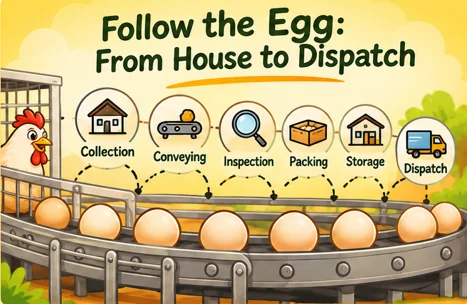
The answer is not always obvious. An egg that arrives cracked has passed through several stages, including collection, conveying, inspection, packing, storage and transport. Damage may be detected at one stage even though it occurred earlier.
Dirty shells can have a similar story. The cause may lie in the laying environment, collection equipment, handling practices or packaging.
The best way to understand these problems is to follow the egg’s journey, stage by stage, and investigate what happens along the way.
1. A good egg is more than an intact shell
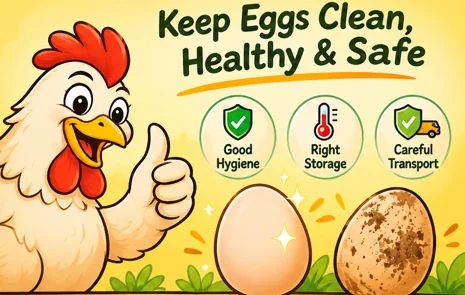
A broken egg is easy to identify. Other quality problems are less obvious and require closer attention.
There are three important questions to ask.
Is the shell intact?
Cracks and fractures can affect whether an egg is suitable for its intended market. Some damage is immediately visible, while finer cracks may be harder to detect.
Is the shell clean?
Dirt and contamination on the shell can indicate problems with the laying environment, collection equipment, handling or hygiene procedures.
Is the egg safe?
An egg that looks clean and has an intact shell is not necessarily free from microorganisms. Contamination can occur during egg formation or after laying. Visual inspection is useful, but it cannot establish microbiological safety.
Buyers may also have specific requirements for shell condition, cleanliness, size and grading. Everyone involved in collection, inspection and packing should understand the applicable specifications.
One important practice is to keep unsuitable eggs separate from acceptable batches. Cracked and dirty eggs should not be mixed back into eggs intended for direct sale as table eggs. Their subsequent handling or disposal should follow applicable food-safety requirements.
Identifying a defect is only the first step. The next is to understand how it happened and what action is appropriate.
2. Follow the egg: Where can problems begin?
The most useful way to investigate egg quality is to walk the same route the eggs take—from the laying house to the dispatch vehicle.
At each stage, look for possible sources of damage, contamination, delays or unnecessary handling.
Stage 1: The conveyor ride
On a farm with automated egg collection, eggs travel along belts, turn corners and move between different sections of the system.
The straight sections may appear to operate smoothly. The more important inspection points are often where eggs change direction, speed or elevation.
Imagine eggs moving from one belt to another. If the belts are misaligned, the gap is too large or the landing surface is hard, the transfer may expose eggs to unnecessary impact or collisions.
Walk along the conveyor while it is operating under normal conditions. Look for:
- Misaligned belts or unstable components.
- Gaps, abrupt drops and hard contact surfaces.
- Eggs accumulating or colliding at transfer points.
- Worn parts, loose fittings or material build-up.
- Differences in movement between connected conveyor sections.
- Unusual vibration or repeated interruptions in egg flow.
Do not assume that a crack detected near a machine was necessarily caused by that machine. Damage may have occurred earlier and become visible later.
Where a particular point is suspected, compare the condition of eggs before and after that point using a consistent inspection method.
Practical takeaway: Pay particular attention to transfers, bends and changes in height—not just the straight sections of the conveyor.
Stage 2: The busy-morning egg room
Now consider the peak collection period.
Eggs are arriving faster than the team can inspect and pack them. Trays accumulate, workers move them to create space, and the packing area becomes crowded.
A tray is lifted, put down and lifted again. The team is trying to keep the line moving, but every additional handling step creates another opportunity for damage.
The problem may not be a shortage of workers. It could be a mismatch between collection speed, conveyor capacity, grading arrangements and available packing space.
Ask yourself:
- When does egg collection peak?
- Where do eggs wait before inspection or packing?
- Can the packing line handle the incoming volume?
- Are trays being lifted or rearranged repeatedly?
- Are workers and equipment getting in each other’s way?
- Does the problem occur on every shift or only at certain times?
An effective egg-room layout should support a clear flow from collection to inspection and packing, with sufficient space for safe handling and cleaning.
If congestion keeps returning, review the workflow, layout, equipment capacity and division of responsibilities. Asking workers to work faster will not necessarily solve a problem caused by the way the system is organised.
Stage 3: The waiting period—storage and dispatch
The eggs have been collected and packed, but the journey is not over.
How long will they wait before dispatch? Are the storage conditions appropriate? Is the dispatch schedule coordinated with the packing operation?
Time and temperature conditions influence the preservation of egg quality. Temperature fluctuations and condensation also deserve attention because moisture on shells can favour microbial growth.
Useful checks include:
- How long do eggs remain in holding areas before dispatch?
- Are storage conditions monitored where appropriate?
- Do significant temperature fluctuations or condensation occur?
- Is the storage area clean and protected from contamination?
- Are dispatch arrangements coordinated with packing and storage capacity?
It is also important to distinguish between different causes of shell damage.
Heat stress in laying birds can affect eggshell quality. After laying, storage conditions influence how well egg quality is preserved. These are separate concerns, and a storage-temperature problem alone does not establish the cause of shell breakage.
Storage and handling procedures should be suitable for the intended distribution chain and the applicable technical and food-safety requirements.
3. The last mile: Packaging and transport
An egg may leave the packing area in acceptable condition and still arrive at the buyer damaged.
Transport introduces vibration, movement, stacking pressure and additional handling. Unsuitable packaging or unstable stacks can increase the risk of breakage.
Before loading, check five things.
Trays and packaging
Are they suitable for the eggs and the intended journey? Are any damaged trays still in use?
Stacking
Are the stacks straight and stable? Is excessive pressure being placed on the lower layers?
Loading and unloading
Are workers handling the packages carefully? Are there unnecessary drops, impacts or rough movements?
Transport conditions
Are eggs protected from contamination, weather exposure and excessive movement?
Delivery feedback
When a buyer reports damage, are the findings recorded and compared with dispatch details?
Comparing inspection records from packing, loading and delivery can help narrow down the possible causes. A consistent record of egg condition at dispatch, together with the buyer’s findings, is especially useful when investigating recurring complaints.
4. Dirty eggs: The problem may start before collection
When eggs arrive dirty, the immediate reaction may be to clean them. But dirt on the shell can be the final sign of a problem that began earlier in the process.
Consider how contamination may be transferred.
A collection belt is not cleaned effectively, allowing residue to build up on a surface that comes into contact with eggs. A worker moves between a manure-handling area and the egg-handling area without following the required hygiene procedures. Reusable trays are used again without being adequately cleaned and dried.
These are different problems, but each can compromise the hygiene of the egg-handling process.
The birds themselves can also contribute to dirty eggs. Not every dirty egg is caused by equipment or poor handling. Sometimes, the condition of the birds and their droppings plays an important role.
For example, hens experiencing digestive disturbances may produce loose, watery or unusually sticky droppings. These droppings can soil the feathers around the vent. During movement in the laying house, contact with other birds or the laying process, this material may transfer to the eggshell.
If dirty eggs are appearing repeatedly from a particular flock or poultry house, it is worth looking beyond the collection system and observing the birds more closely. Check for unusual droppings, soiled feathers around the vent, changes in feed intake, reduced production or other signs that may indicate a health problem.
- Gut health and intestinal disturbances: Digestive problems can result in loose or watery droppings, increasing the possibility of eggshell contamination.
- Intestinal infections: Certain diseases, including coccidiosis, can cause diarrhoea and, in some cases, bloody droppings. These signs should not be ignored and require appropriate veterinary assessment.
- Feed-related factors: Certain feed ingredients, high levels of indigestible material or nutritional imbalances may contribute to wet droppings. Feed formulation and ingredient quality should be reviewed when the problem is recurring.
- Drinking-water quality: Water quality is another factor worth checking. For example, high salt levels in drinking water may contribute to wet droppings.
- Vent and feather cleanliness: Birds with pasted or soiled feathers around the vent may indicate a need to investigate flock health and hygiene conditions.
Dirty eggs do not automatically mean that the birds are diseased. Nest conditions, wet litter, delayed collection, equipment cleanliness and handling practices can also be responsible. The important thing is to identify whether the problem is coming from the bird, its environment or the egg-handling process - or a combination of these factors.
If abnormal droppings or other signs of illness persist, consult a poultry veterinarian. Review the birds' condition, feed and water quality, and the management of the affected house before deciding on corrective action. Treating only the dirty eggs without investigating the possible underlying cause may allow the problem to continue.
A practical hygiene review should cover the following areas.
| Area | What to check |
|---|---|
| Equipment and surfaces | Are belts, collection equipment and work surfaces cleaned on a defined schedule? Is cleaning effective, including in hard-to-reach areas? |
| Clean and dirty activities | Are egg handling and manure or waste handling separated wherever practical? Are movement routes designed to minimise cross-contamination? |
| Personnel hygiene | Are hand hygiene, protective clothing and movement between houses and handling areas managed appropriately? |
| Trays and packaging | Are trays inspected before use? Are reusable trays cleaned and dried using methods suitable for their design? |
| Pests and waste | Are pest-control measures maintained and waste removed without compromising egg-handling hygiene? |
| Egg cleaning | Are any permitted cleaning procedures properly controlled and consistent with applicable requirements? |
| Bird health and droppings | Are loose or watery droppings being observed? Are feathers around the vent clean? Are there signs of digestive disturbances or illness in a particular flock or house? |
| Feed and drinking water | Has feed quality, ingredient composition and drinking-water quality been reviewed if abnormal droppings are recurring? |
Do not assume that washing or soaking eggs is a suitable general solution. Where cleaning is permitted, the method must be appropriately controlled and consistent with the requirements that apply to the operation.
Cleaning does not replace the need to separate unsuitable eggs or maintain appropriate food-safety controls.
Good hygiene is not one task performed at the end of collection. It is part of the entire egg journey, beginning with the health and management of the birds.
5. Cracked eggs: Investigate the system, not just the person
When the number of cracked eggs increases, it is easy to focus on the person handling them.
Staff training and careful handling are essential. However, repeated damage can also involve equipment, workflow, flock conditions or the farm environment.
Use the following questions to guide your investigation.
| Area | Questions to ask |
|---|---|
| Collection equipment | Are transfer points smooth, aligned and operating consistently? |
| Handling practices | Are workers following suitable procedures? Is there repeated lifting or rough movement? |
| Egg-room workflow | Is congestion creating additional handling or delays? |
| Shell quality | Could flock age, nutrition, health or other biological factors be involved? |
| Environment | Are ventilation, temperature and other relevant conditions being managed appropriately? |
| Packaging and transport | Are trays, stacking arrangements and loading practices suitable? |
Consider an example. An older flock may produce eggs with weaker shells. At the same time, a transfer point may be slightly misaligned.
The eggs may be more vulnerable to damage, and the transfer may introduce additional mechanical stress. Looking at only one factor could miss the combined effect.
The correct response is to investigate the evidence rather than automatically blaming the worker, the machine or the flock.
If the cause remains unclear, seek advice from the appropriate equipment, nutrition or veterinary specialist.
6. Let your records tell the story
A farm that does not record quality problems consistently will find it difficult to understand recurring complaints.
Without records, each complaint can feel like a new surprise. With records, patterns may become visible:
- The problem occurs more often during the afternoon shift.
- Defects increase after a change in trays or packaging.
- More damage is detected in one section of the conveyor.
- Dirty eggs are associated with a particular handling or hygiene issue.
- Dirty eggs are repeatedly observed in a particular poultry house along with loose droppings or soiled feathers around the vent.
A simple egg-quality register can help identify these patterns.
| Record | What to capture |
|---|---|
| Date and source | Collection date, laying house and batch identification |
| Quantity | Number of eggs collected and inspected |
| Shell defects | Cracked or damaged eggs, recorded separately |
| Cleanliness | Dirty or contaminated eggs, recorded separately |
| Other defects | Relevant grading or quality issues |
| Detection stage | Collection, transfer, egg room, packing, dispatch or delivery |
| Observations | Equipment condition, congestion, handling and storage conditions |
| Flock-health observations | Unusual droppings, soiled feathers around the vent, visible signs of illness or changes in flock condition |
| Corrective action | What was adjusted, repaired or changed |
| Follow-up | Whether the problem continued after the action |
| Dispatch feedback | Delivery findings and buyer complaints |
A spreadsheet or paper register is sufficient to get started, provided it is completed consistently and reviewed regularly.
One rule is especially important: record what you observed separately from what you believe caused it.
For example:
- Observation: Cracked eggs were detected during packing.
- Investigation: More defects were also detected after a particular transfer point.
- Corrective action: The transfer alignment was inspected and adjusted.
- Follow-up: Defect levels were monitored using the same inspection method.
This creates a clear record without assuming that the first observation identifies the actual cause.
When comparing results before and after a change, consider other relevant factors, such as flock age, production volume, weather, operating conditions and inspection methods. Otherwise, an apparent improvement or deterioration may be misleading.
Maintain batch identification and traceability appropriate to the operation so that quality and food-safety concerns can be investigated effectively.
7. One connected process: From collection to dispatch
Collection, conveying, inspection, packing, storage and dispatch are not isolated jobs. They are connected stages of one process.
A problem in one area can create additional work or introduce risks elsewhere. Improving a single component may not resolve the issue if the wider workflow remains unchanged.
A useful review starts with an observed problem and follows the egg's journey to identify the likely contributing factors.
Depending on the findings, the appropriate action may include:
- Maintaining or adjusting collection equipment.
- Improving conveyor transfers or coordinating belt operation.
- Revising the egg-room layout and workflow.
- Updating handling procedures or providing additional training.
- Reviewing trays, packaging and transport practices.
- Strengthening cleaning, hygiene and traceability procedures.
- Reviewing flock health, droppings, feed and drinking-water quality where bird-related causes are suspected.
- Seeking specialist assessment of flock health, nutrition or environmental conditions.
Automation can help where repetitive handling, inconsistent movement or poorly balanced processes contribute to problems. However, it does not replace hygiene controls, inspection, staff training, flock management or equipment maintenance.
For some farms, a maintenance adjustment or revised procedure may be sufficient. Others may benefit from targeted equipment upgrades or a more comprehensive review of their egg-handling system.
Your next farm walk: A 10-point checklist
The next time you inspect your farm, follow the egg's journey from the laying house to the dispatch vehicle.
- Inspect conveyor transfers, belt alignment and every point where eggs change direction or height.
- Check whether eggs accumulate, collide or require unnecessary manual handling.
- Compare collection, inspection, grading and packing capacity.
- Verify that equipment, work surfaces and reusable trays are maintained hygienically.
- Review storage conditions, holding times and dispatch arrangements.
- Check tray condition, stack stability and loading practices.
- Record cracked eggs, dirty eggs and other defects separately.
- Observe the birds, droppings and feather cleanliness around the vent, particularly when dirty eggs repeatedly come from the same house.
- Identify where defects are first detected and investigate possible causes.
- Assign responsibility for corrective actions and check whether they work. Seek specialist advice when flock health, nutrition or food-safety concerns require further assessment.
These checks provide a practical starting point for identifying weaknesses and deciding where further investigation or improvement is needed.
Every stage matters
Let us return to that Tuesday morning phone call.
The next time a buyer reports cracked shells or dirty eggs, begin with a different question.
Instead of asking, “Who made the mistake?”, ask, “Where did the egg's journey go wrong?”
An egg's condition at delivery reflects several factors: flock health, the production environment, equipment, handling, hygiene, storage and transport. Cracks, dirt and inconsistent grading are not simply reasons to assign blame. They are signals that deserve investigation.
Whether a farm uses manual handling, semi-automated equipment or an integrated egg collection system, the principle remains the same: examine the whole process, maintain reliable records and address the causes identified by the evidence.
Because every egg has a journey, and better quality begins with understanding it.
Reviewing your egg-handling setup?
Farmers planning a new layer farm or reviewing an existing system can contact Gartech to discuss farm layouts, equipment and operating requirements.
Email: sales@gartech.co.in
Website: gartech.co.in
Every egg has a journey. Make quality a consideration at every stage.
 LinkedIn
 Twitter
 WhatsApp
 Copy Link
 Gary-AI ChatBot
 Send Enquiry
 Bird Calculator
 whatsapp
